In today’s fast-paced digital world, video content is essential. From onboarding new employees to launching global marketing campaigns, video is the most engaging medium. However, traditional video production is notoriously slow, expensive, and inflexible. Imagine spending weeks coordinating with actors, booking studios, and managing a film crew, only to find a critical error in the script or realize you need the video in five different languages by next week. The costs and delays can be staggering.
This is the exact friction point where generative AI is making its most significant impact. The technology behind the ai avatar generator has matured from a niche novelty into a powerful business tool. It’s no longer about creating cartoonish animations; it’s about producing realistic talking avatars that can serve as brand representatives, trainers, and communicators. This article will demystify the technology, explore its practical applications in real-world business scenarios, and look ahead to the future of digital human communication.
What Is “Talking Avatar” AI Technology?
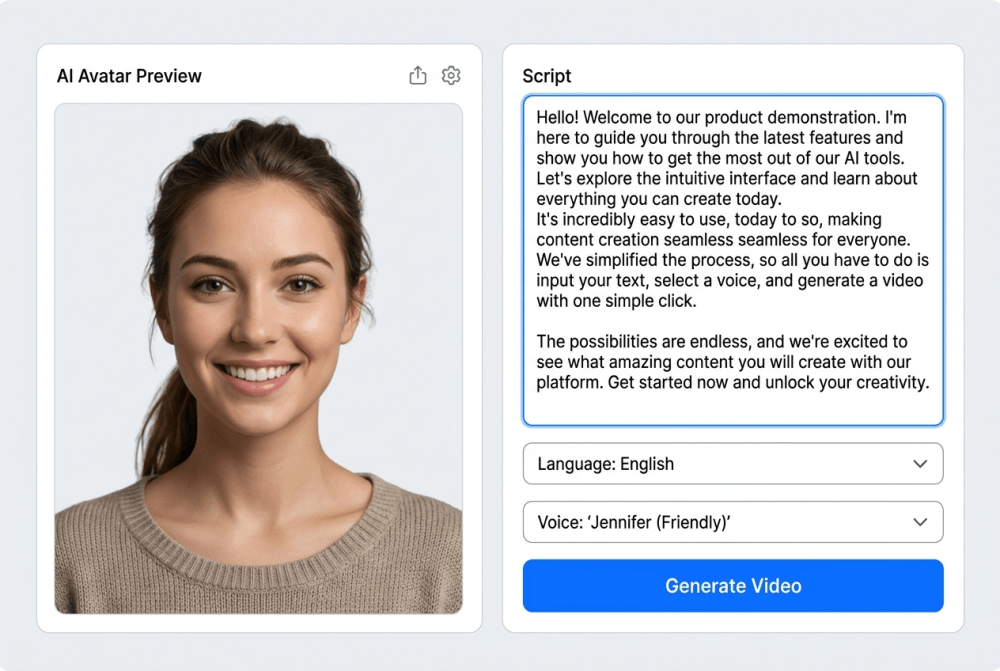
At its core, “talking avatar” technology is a sophisticated blend of several artificial intelligence disciplines. It’s not a single AI, but rather a system where multiple AIs work in concert. The goal is to take two simple inputs—a text script and a visual image of a person—and generate a completely new video of that person speaking the script with synchronized lip movements, natural expressions, and authentic voice.
Think of it as a digital puppeteer. One AI is the “voice,” another is the “face,” and a third is the “director” that syncs everything together. This creates a powerful workflow where a static AI character is brought to life, capable of delivering any message you write, in virtually any language.
How It Works (A Light Technical Overview)
You don’t need a degree in computer science to understand the magic behind an AI avatar maker. The process can be broken down into three main stages:
1. Text & Voice Synthesis: First, you provide your script. A powerful text-to-voice engine analyzes this text. This isn’t the robotic voice of early GPS systems. Modern neural AI tools interpret punctuation and context to generate a human-like audio track, complete with natural pacing, intonation, and pauses. You can choose from hundreds of voices and accents to find the perfect tone for your message.
2. Facial & Lip-Sync Generation: This is where the visual magic happens. A separate AI model, often a type of Generative Adversarial Network (GAN), analyzes the audio file produced in the first step. It breaks the sound down into phonemes (the smallest units of sound in speech, like ‘f’, ‘m’, ‘ooh’). The AI has been trained on thousands of hours of video of human speech, so it knows exactly how the lips and facial muscles should move to create each sound. It then generates the corresponding facial movements for your chosen AI avatar model.
3. Synchronization and Rendering: In the final step, the system meticulously synchronizes the generated audio track with the generated facial animation video frames. It layers in other elements like subtle head movements, blinks, and eyebrow raises to create a believable performance. This composite video is then rendered and delivered to you as a high-quality MP4 file, ready for use.
Why It Matters (The Value Proposition)
The “how” is fascinating, but the “why” is what makes this technology so compelling for businesses and content creators:
● Massive Scalability: Once a script is finalized, you can generate videos with dozens of different avatars or in dozens of different languages with just a few clicks. This is impossible with traditional filming.
● Drastic Cost Reduction: It eliminates the costs associated with actors, studios, camera equipment, travel, and post-production crews.
● Unmatched Speed and Agility: Need to update a product feature in a demo video? Simply edit a line of text and re-generate. A process that once took weeks now takes minutes.
● Total Consistency: Your brand’s AI character will always be on-message, have perfect delivery, and never have a bad hair day. This ensures a consistent brand image across all your communications.
Practical Use Cases of Realistic Talking Avatars
This technology moves from “cool” to “critical” when applied to specific business needs. Here are a few scenarios where an ai avatar generator is already streamlining workflows.
On-Demand Corporate Training and Onboarding
The Scenario: A fast-growing company needs to onboard 50 new remote employees each month. Previously, this required live-scheduled webinars, which were difficult to coordinate across time zones and resulted in inconsistent delivery by different trainers.
The AI Solution: The HR department creates a series of training modules using a single, friendly, and professional AI avatar model. The AI character explains company policies, software tutorials, and compliance procedures. New hires can access these videos 24/7. When a policy changes, the video is updated in minutes by simply editing the script, ensuring everyone receives the exact same, up-to-date information.

Localized Marketing and Product Demos
The Scenario: A software company wants to launch its new product in Europe and Asia. Traditionally, this would mean hiring local actors and marketing teams in each country to re-shoot their English-language product demo—a costly and time-consuming process.
The AI Solution: The marketing team finalizes one master product demo video script. They then use an ai avatar generator that supports multiple languages. With the same avatar, they generate the demo video in German, French, Spanish, Japanese, and Korean. The text-to-voice engine ensures a native-sounding accent for each language, allowing them to execute a global launch simultaneously and on a fraction of the budget.
Personalized Customer Support and FAQ Videos
The Scenario: A customer support team is overwhelmed with repetitive questions about how to perform a specific function in their app. Writing long FAQ articles is time-consuming, and many users don’t read them.
The AI Solution: The support team creates short, 1-minute video tutorials for the top 20 most frequent questions. Using a helpful-looking AI character, they walk users through the steps visually. These videos can be embedded directly in the FAQ section or sent automatically by a chatbot in response to a customer’s query, dramatically reducing ticket volume and improving customer satisfaction.
Scalable Educational Content Creation
The Scenario: A university professor wants to create an online course but dislikes being on camera and lacks the time and resources for professional video production.
The AI Solution: The professor chooses one of the available realistic talking avatars to act as the course instructor. They can focus entirely on writing high-quality lecture scripts and learning materials. The AI avatar maker handles the entire video production, delivering a full course of polished, consistent-looking lectures, freeing the educator to do what they do best: teach.
Tools Supporting This Workflow
The growing demand for this technology has led to the emergence of powerful, user-friendly platforms designed for this exact purpose. The best AI tools in this category don’t just provide an avatar; they offer an end-to-end video creation studio in the cloud. They integrate a diverse library of pre-made avatars, a state-of-the-art voice synthesis engine, and a simple video editor for adding backgrounds, text, and music. Platforms like Synthesia, HeyGen, and Vokes AI are leading this space, offering integrated workflows that take you from a simple script to a finished video in minutes, empowering non-technical users to become proficient video creators.
Future Trends in AI Avatar Technology
The field is evolving at a breakneck pace. What we see today is just the beginning. Here are a few trends to watch:
● Emotional Intelligence: The next generation of text-to-voice engines will not only pronounce words correctly but also infuse them with genuine emotion derived from the script’s context. An AI character will be able to sound excited about a product launch or empathetic when delivering sensitive news.
● Full-Body and Interactive Avatars: We will move beyond the “talking head” format. Avatars will have full-body animation, allowing them to gesture, walk, and interact with on-screen elements, making presentations and tutorials far more dynamic.
● Real-Time Generation and Interactivity: Instead of pre-rendering videos, future AI avatar generator technology will be able to create avatar responses in real-time. Imagine a customer service chatbot that is a fully interactive, talking avatar, or a live presentation where you can type a message and have your avatar deliver it instantly.
● Personalized Digital Twins: The ability to create a custom AI character from a single photo will become more refined, leading to the creation of hyper-realistic “digital twins.” Professionals will use their own avatars to handle repetitive communication tasks, scaling their personal presence without sacrificing time.
● Ethical Frameworks and Watermarking: As the technology becomes indistinguishable from reality, the industry will implement stronger ethical guidelines and invisible watermarking to prevent misuse and ensure transparency, clearly distinguishing AI-generated content from real human footage.
Conclusion
AI-driven realistic talking avatars have crossed the threshold from a technological curiosity to a practical and strategic business asset. By automating the most labor-intensive and costly aspects of video production, they empower businesses of all sizes to communicate more effectively, train their teams more efficiently, and reach global audiences more easily.This technology is not about replacing human creativity but augmenting it. It handles the repetitive, technical tasks of video production, freeing up marketers, trainers, and creators to focus on what truly matters: crafting a compelling message. As the tools become even more accessible and powerful, the ability to turn text into a professional video with a lifelike AI character will become a fundamental skill in the modern digital toolkit.